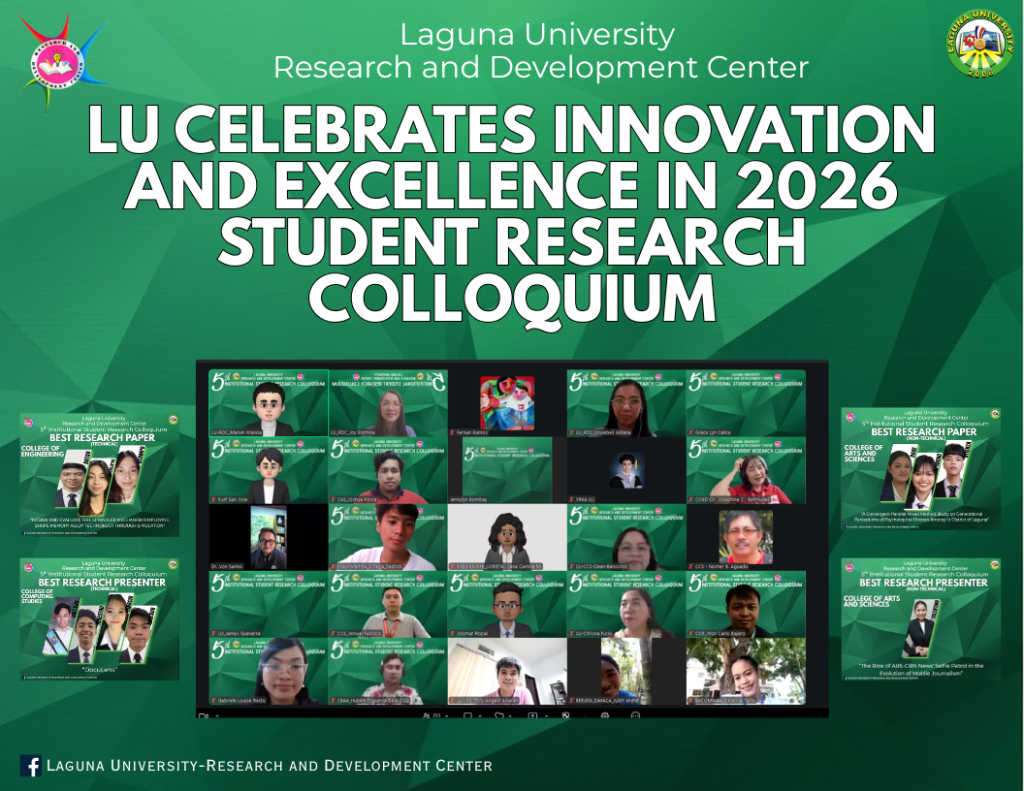
Laguna University-Research and Development Center successfully hosted the 5th Institutional Student Research Colloquium on May 21, 2026, via Zoom, bringing together student researchers, faculty members, and academic leaders to celebrate innovation, collaboration, and research excellence.
Carrying the theme, “Shaping Tomorrow Through Collaboration and Excellence: Building a Community of Innovative Thinkers and Future Leaders in Research,” the virtual colloquium highlighted the significant contributions of student-led research across various academic disciplines.
In her opening remarks, Dr. Marie Joy Q. Elomina, Research Director, reminded the student-researchers that their papers are more than a school requirement. “The papers and presentations you share today are not just requirements for graduation or lines in your resumes. They are your contributions to the global conversation. They are the seeds of innovation that have the power to shape our collective tomorrow,” Dr. Elomina emphasized.
In addition, Dr. Marlon L. Atanacio, Vice President for Academic Affairs, said that the colloquium serves as an important platform for collaboration and innovation. According to him, “Through this colloquium, we are given the opportunity to learn from one another, appreciate diverse perspectives, and engage in meaningful academic exchange.”
Meanwhile, Dr. Charlemagne G. Laviña, University President, shared that innovation is not merely human intervention; it is a divine inspiration. “Wisdom, understanding, and knowledge are poured into a human mind for a divine purpose. This means that the very breakthrough of science, every new methodology in research, and every creative solution to human problems are ultimately rooted in God’s generosity of wisdom,” Dr. Laviña explained.
Serving as the keynote speaker, Dr. Von L. Sarino, President/CEO of QualiSearch Center for Interdisciplinary Research and Development, encouraged the participants to continue asking questions, building ideas together, pushing boundaries, and becoming the kind of leaders our country needs today.
During his talk, Dr. Sarino highlighted the younger generation’s responsibility to rebuild trust, restore integrity, humanize innovation, defend the truth, and lead with compassion. collaboration over competition.
Afterward, the participants were divided into two breakout sessions: the non-technical category (CAS, CBAA, and COED), moderated by Mr. Ronnel Palasin, and the technical category (CCS and COEng), moderated by Ms. Maria Steffanie Badulis. The panel members in the breakout session 1 were Dr. Delon Ching, Mr. Johnmark Lafavilla, and Ms. Gabriele Louise Recto. In the breakout session 2, Engr. Romeo Solitario Jr., Engr. John Carlo Bajaro, and Mr. Kurt Robin San Jose served as the panel members.
In the non-technical category, Claire Tolentino (CAS-BA Comm) received the Best Research Presenter award for her study, “The Role of ABS-CBN News’ Selfie Patrol in the Evolution of Mobile Journalism.” Meanwhile, the research titled “A Convergent Parallel Mixed Method Study on Generational Perceptions of Psychological Distress Among IV District of Laguna,” conducted by Kyla Camille C. Rabe, Mycca A. Afurong, and James Harold A. Atienza (CAS-BSPsy), was recognized as Best Research Paper.
In the technical category, representatives from CCS (BSCS-DS), Rouin A. Vallejo, Jomar D. Maestro, Iner Jaime A. Collado Jr., and Sweet Katrina Bianca M. Ignacio earned the Best Research Presenter award for their study, “DocuLens.” Additionally, the study “Design and Evaluate Fire Sprinkler Mechanism Employing Shape Memory Alloy Technology Through Simulation,” by Mheeka Joyce M. Ocampo, Danica Jane A. Macalintal, and Johnlloyd S. Batao from the College of Engineering (CoEng-BSME), was awarded Best Research Paper.
On behalf of Dr. Norayda M. Dimaculangan, Student Research Coordinator, Dr. Elomina delivered the closing remarks, congratulating the winners of this year’s student research colloquium.
Through the successful conduct of the colloquium, the university reinforced its commitment to academic inquiry, research excellence, and transformative learning within the academic community.
Written by: Louiebell P. Alillana & Marie Joy Q. Elomina, Ph.D.